June 2026
Last month's mention of the bronze bell belonging to my house reminded me that I have another bronze bell. It's a little memento that sits on a bookshelf, but its real home is in 'Memory's Rucksack':
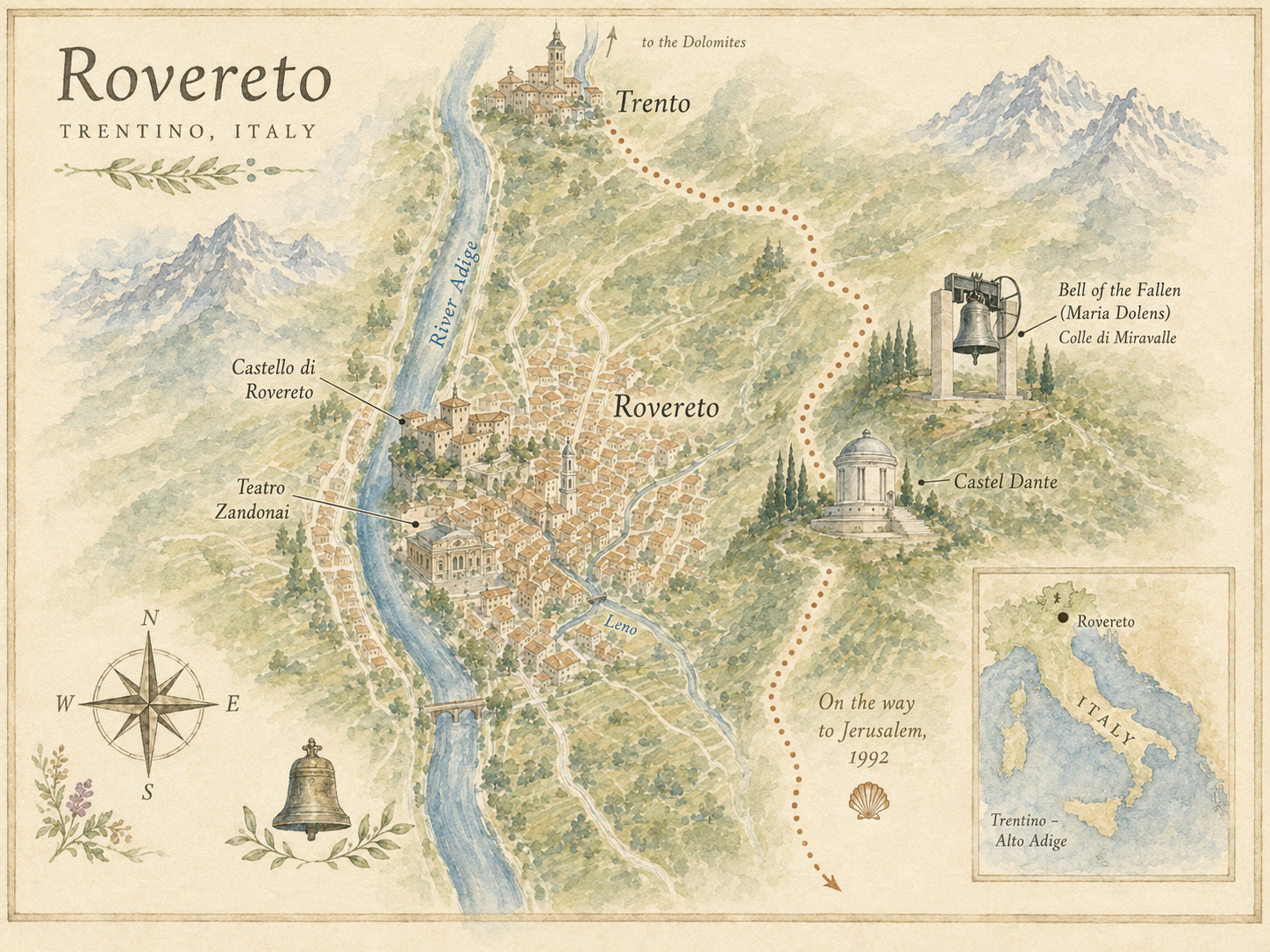
In the autumn of 1992, when I was walking through Italy's Trentino region on my way to Jerusalem, I was invited by the local MS Society chapter to stop in the town of Rovereto. The idea was that I should visit its rehabilitation centre, meet the organisers and give a talk, and on the following day, attend the Remembrance Sunday service with them.
The date was 1 November: 'Ognisanti', or 'the Feast of All Saints', a national holiday. The town was packed. The streets were decorated, everyone was dressed in style, heading for the vast esplanade at the top of the town where the remembrance celebration and an open-air Mass would be held. Though I was impressed by Rovereto, I can do little more here than mention its situation, extending along the valley of the river Adige, and its major monuments. These include an imposing castle, an enchanting 17th-century theatre, and Castel Dante, a war memorial where more than 20,000 soldiers from all over Europe as well as from Italy are buried and identified by name on the walls.
Rovereto has become known as a Peace Town, but what I really want to tell you about is 'the Bell of the Fallen'. Its creation was inspired by a young priest, Fr. Antonio Rossano, appointed to Rovereto just after the end of thr First World War. He and others were responsible for setting up Italy's first War Museum there in 1920, but Rossano's personal vision was of a memorial that aimed to convert humanity to the ideal of peace: the conviction that there should be 'No More War'. From his diary, quoted on various websites dedicated to 'la Campana di Caduti' we learn of his idea of casting a bell using the bronze of cannons donated by every nation that had fought in the 1914-1918 War. The gentle diplomacy involved in obtaining these cannons took five years, but in 1925 the enormous bell was cast in the nearby city of Trento. It measures more than 3.5 metres high and weighs more than 22 tons. A huge concrete and wooden structure was built to move and support it. It was, and remains, the second-largest freestanding cast bell in the world. It was given the name 'Maria Dolens' to signify the grief of those - especially mothers - who have lost loved ones in war, but it is better known as 'the Bell of the Fallen'. In 1928 there began the custom that has made Rovereto and its bell famous: the 100 tolls that ring out every evening in memory of those lost in war, without distinction of nation, race or religion. With the exception of the brief periods needed for maintenance, 'the Bell of the Fallen' has continued to call people to remembrance every evening since. My hosts later told me that the citizens of Rovereto habitually stop in the streets when the tolling begins and wait until it has finished before moving on.
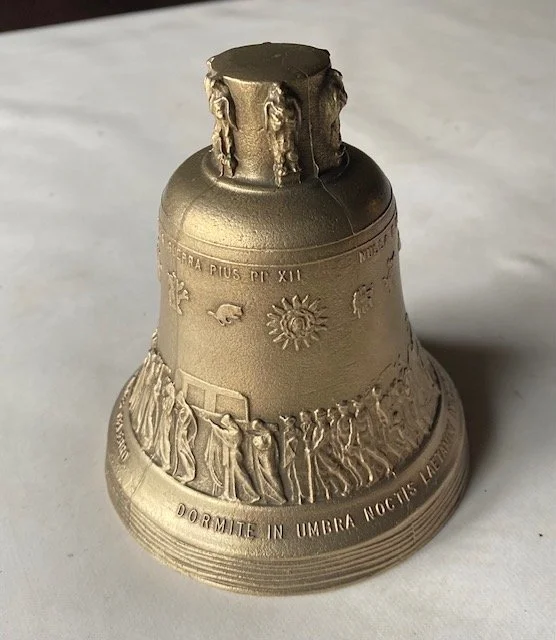
At the conclusion of the open-air Mass on that Remembrance Sunday, the gigantic bell was wheeled onto the esplanade and made to toll, slowly, 100 times, while from the vast crowd there was barely a sound. When the tolling ceased, a youth choir and orchestra performed works on the theme of peace, many in the crowd joining in. I was delighted to hear, among the musical offerings, some that I knew, and had the sense that the concert was intended to be international in its appeal.
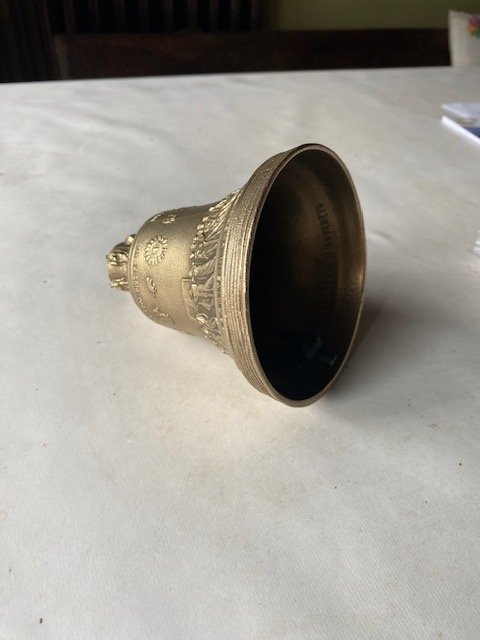
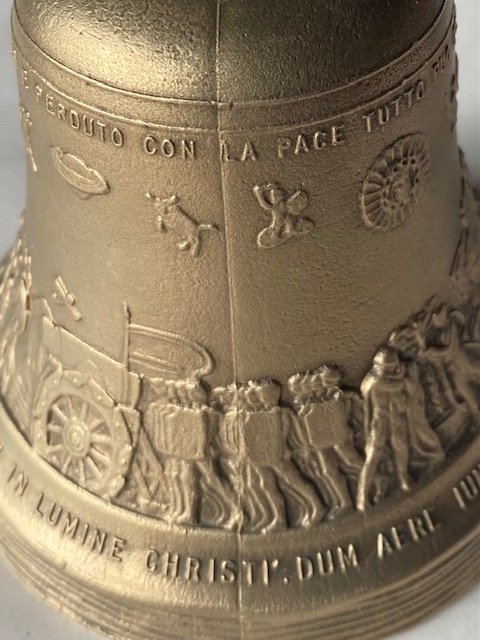
When it was over there was a long period of applause before the crowd began to break up. My hosts guided me back to their car but it was some time before I could speak, so moved was I by that simple but powerful tribute to loss, and to life. Before I left the next morning, they handed me a small box, the gift of Rovereto's town council. Inside was the replica of 'the Bell of the Fallen' you see above, whose message is more urgent, yet seemingly less heeded, now than ever.