August 2026
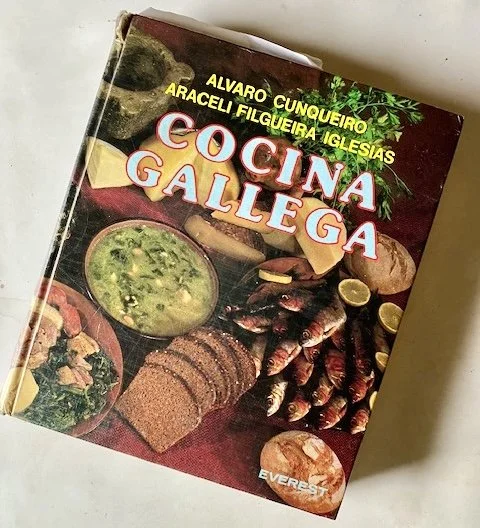
Vegetable gardens are beginning to reward us this month, and to challenge us, too, with how to make the most of the abundance without haste or waste. Faced with a bag of tomatoes or courgettes left at my door (I, like the young Garrison Keillor, having stealthily left bags of beans at my neighbours'), I invariably turn to Alvaro Cunqueiro's 'La Cocina Gallega', which can mean both 'The Cooking of Galicia' and 'The Galician Kitchen'.
My copy was given to me by friends, soon after the eighth edition was published in 1989. This was the first book devoted to the traditional food culture of Galicia that aimed to recreate an awareness that an earlier generation would have taken for granted. Today there are many such books, just as there are innumerable restaurants specialising in the varied products of Spain's north-west. If visitors are curious enough to seek out such establishments, they'll not lack opportunities to sample the game and seafood, the soups, cheeses and meat dishes, the chestnut and walnut-based sweets, that feature in Galicia's cuisine.
Alvaro Cunqueiro (1911-1978) was an outstanding literary figure: a man who read widely and wrote prodigiously in nearly every genre. He was also a journalist and editor, latterly of the Faro de Vigo newspaper, and a great defender of Galicia's language and culture. Parallel to all this ran a passionate interest in the region's historic gastronomy, including its wines. His 82-page Introduction to The Galician Kitchen is simply enthralling (at least to me), so wide-ranging are the references and so deftly interwoven the observations and touches of humour. In one section he discusses Galicia's reliance on pork, its byproducts and their uses, and in another, the qualities of soil favourable to wild strawberries, the shapes and scents of native apples and the origins of grape varieties, all the while citing authors from across the centuries and half a dozen languages. As to the 676 recipes themselves, collected and arranged by his colleague Araceli Filgueira Iglesias, they have been kept simple: the readily available ingredients appear on the left, measured out in sometimes enormous quantities (families were large, and working appetites, too). Methods, on the right, are unfussy ('leave to boil hard for half an hour') but some require multiple stages extending over several days.
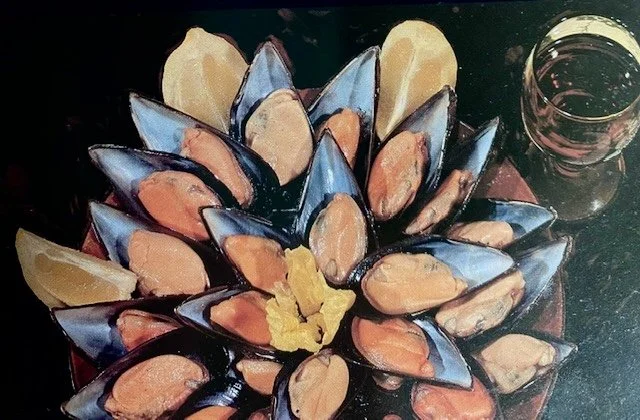
Mussels on the shell
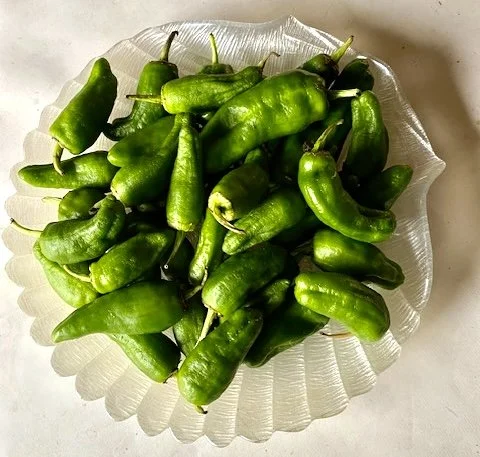
Pimientos de Padron